Desk Stationery Checklist: 12 Essentials for a Tidy Home Office
There is a particular kind of clutter that builds on a home office desk. It is not dramatic. It is the slow arrival of pens that half work, three notepads with four pages used, a highlighter that dried out last spring, and a stapler with no staples in it.
Working around that isn’t a disaster, but it is friction. You reach for something, find the wrong version of it, spend twenty seconds hunting, and lose the thread of whatever you were doing. The answer is rarely a bigger drawer. It is a shorter list — twelve items that cover almost everything a desk needs, each with a home close to hand.
Three rules before you buy anything
Stationery multiplies quietly. A few rules keep the population under control:
- Weekly use. If you don’t touch it at least once a week, it belongs in a storage box, not on the desk.
- One job, done well. A cheap multi-tool pen that writes badly and refuses to open envelopes is three problems dressed as one solution.
- A home within reach. Anything without a place will end up loose on the surface by Thursday.
Be strict about spares
Keep a spare only of the things you’d genuinely stop working without: a pen refill, a roll of tape, staples. Everything else gets replaced when it runs out, not before. A drawer full of “just in case” pens is how desks become stationery cupboards with a laptop on top.
The 12-item desk stationery checklist
- One pen you enjoy writing with. One, not five. If it takes refills, keep a spare refill in the drawer; if it doesn’t, keep an identical backup.
- A pencil. Mechanical, or an HB with a small sharpener. Anything you might want to change later is easier in pencil.
- One highlighter. A single colour handles most home office work. A second only earns its place if you mark up documents someone else also reads.
- A fine-tip marker. For labelling archive boxes, ring binders and folders before they go into storage — and the occasional unnamed charging cable.
- Correction tape. The dry tape type: no drying time, no smell, nothing to spill into your keyboard.
- Sticky notes, one pad. Choose a size and stay with it. Mixed sizes end up stuck to the monitor, the wall and each other.
- An A5 notebook. Small enough to sit open beside the keyboard, large enough for a meeting or a to-do list that survives the week.
- A4 paper. A pad for handwritten work and rough layouts, plus a modest stack of loose sheets for the printer.
- Scissors. Keep a small pair for paper and tape only. They stay sharper longer and stop migrating to the kitchen drawer.
- Tape, and a glue stick if you need one. A weighted dispenser is worth it; loose rolls disappear into the void.
- A 15 cm metal ruler. Metal, because the edge stays true and doubles as a straight edge when you trim something.
- Clips and a stapler. A loaded stapler, a small tin of paper clips, and two or three bulldog clips for thick documents that a staple won’t hold.
Notice what isn’t on the list: correction fluid, three-colour pen sets, novelty organisers, a second highlighter, four notebooks. None of them are wrong to own. They simply don’t need to live on the desk.
If something hasn’t been used in three months, it’s storage, not equipment.
Somewhere to put it all
On the surface
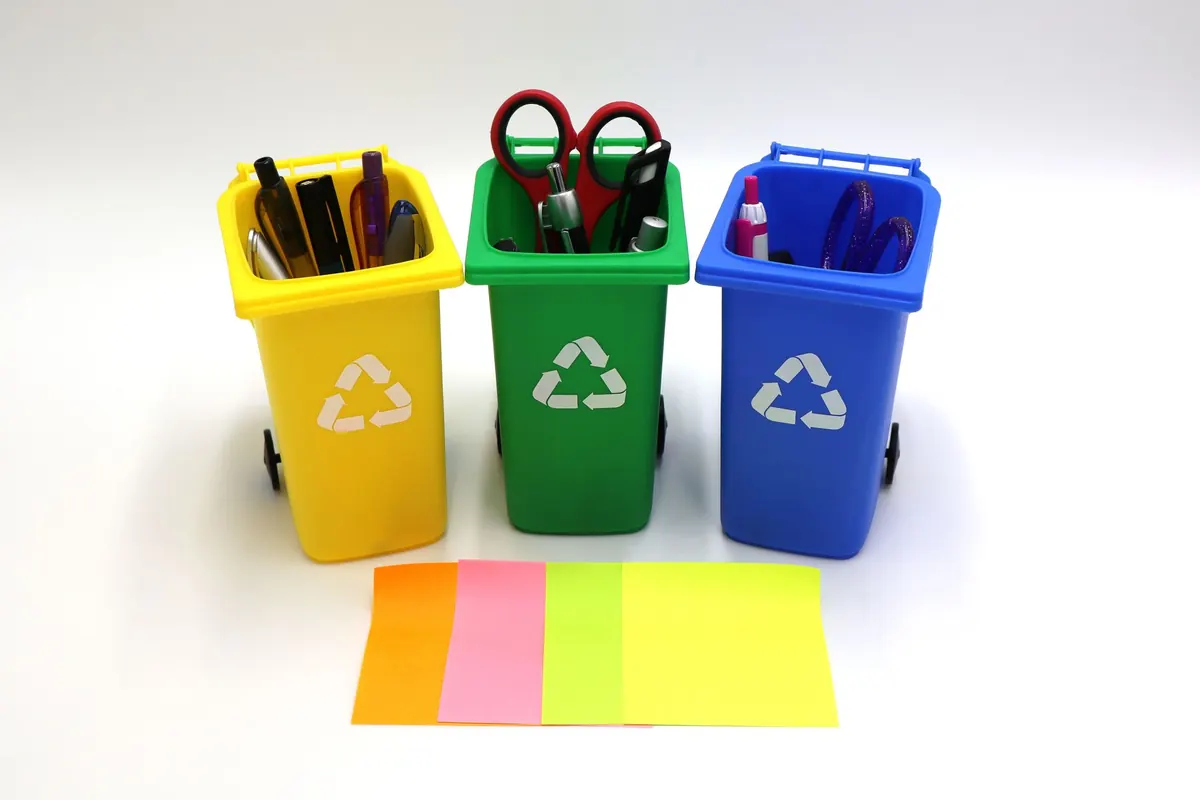
A single pen pot is enough for the pen, pencil, scissors, ruler and marker. If you prefer things lying flat, use a shallow tray instead. Either works; what matters is that daily items have one obvious place rather than drifting loose across the desk.
In the drawer
Use the shallow drawer nearest your chair, split with two small boxes or a simple divider insert. One section for refills and tape, one for clips and staples, one for paper. Treat this drawer as restocking space, not overflow. When it stops closing easily, something needs to leave.
Paper that arrives
Post, receipts and forms need a route off the desk, not a pile on it. A single letter tray or box file is enough. Empty it once a week: file it, act on it, or bin it.
The five-minute weekly reset
Pick a time — Friday afternoon works well — and run through this in one pass:
- Tip out the pen pot and bin anything that doesn’t write.
- Return stray pens, clips and notes to their homes.
- Wipe the surface, including under the keyboard and monitor stand.
- Clear the letter tray completely.
- Restock staples, tape, sticky notes and paper before you run out mid-task.
Five minutes a week is far less effort than an hour of tidying every few months, and it keeps the desk usable on a bad Tuesday.
Printing and using the checklist
Print the twelve items at A5 and keep the list somewhere you’ll actually see it: inside a cupboard door, taped to the back of a drawer, or on the inside cover of your notebook. Tick each item as you set the desk up, then write the date on it and revisit every three months.
The point isn’t to achieve a perfect desk in one afternoon. It’s to have a clear picture of what “right” looks like, so you notice drift while it’s still small. If the desk is shared, give each person a labelled pot or a labelled drawer section — merged stationery is how the clutter starts all over again.
Adjust the list, don’t grow it
Two or three personal additions are reasonable. Someone who sketches will want a small set of pencils and a decent eraser; someone who journals will want a second notebook; someone who posts a lot of parcels will want a permanent marker and a tape gun. Add them, but make each addition replace something or pass the weekly-use test.
The aim is a desk where everything within reach gets used and everything used has a place. That is what a tidy home office really is — not an empty surface, but a well-edited one with nothing extra left to tidy.
Photo: SiljeAO - / Pexels

How to Organise Cables and Chargers Without Hiding Your Desk Decor
Cable management that keeps chargers tidy without emptying your desk: simple routes, clips, trays and...
Spring Refresh: 10 Floral Desk Decor Ideas Using British Blooms
Ten seasonal arrangements for a spring desk using British-grown blooms, plus practical advice on choosing,...
About Us